
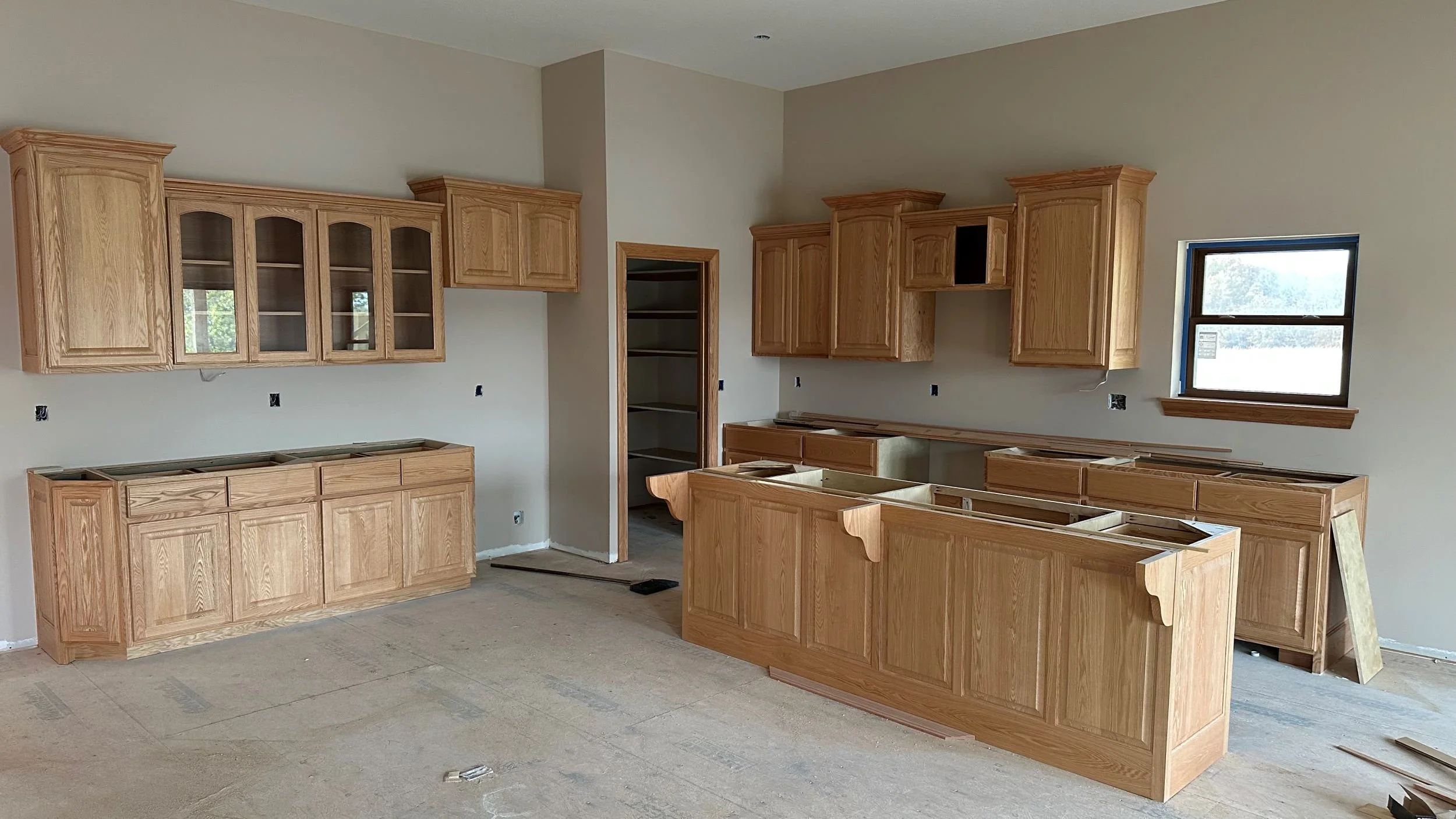
Rift-Sawn Architectural White Oak
When designing an elite interior, wood selection is never merely a cosmetic choice; it is an engineering decision that dictates whether your millwork retains its crisp alignment or succumbs to seasonal movement. In our Kansas and Missouri climate, dramatic shifts in temperature and relative humidity subject interior timber to immense mechanical tension. When commissioning rift sawn white oak cabinetry Kansas City homeowners can depend on for generational longevity, material geometry is everything. Rift-sawn architectural white oak provides the singular combination of structural equilibrium, straight linear grain, and timeless warmth required to elevate custom casework into permanent architectural art.
Every board we curate for luxury residences meets our baseline standards for high-performance materials. By pairing strict milling specifications with uncompromising installation protocols, we eliminate the displacement stress of binding drawers, shifting reveals, and cracked finishes.
The Anatomy of Dimensional Stability: Why Rift-Sawn Cuts Prevail
Standard plain-sawn lumber is milled tangentially across the log, producing expansive cathedral grain patterns. While visually dramatic, these grain arches expand significantly across their width whenever Midwestern summer humidity peaks, leading to cupped door panels and warped stiles.
Rift sawing solves this failure point at the saw blade. By cutting the log at a precise 45-degree angle to the growth rings, the sawyer produces timber with a strictly vertical, linear grain orientation.
Radial Equilibrium: Because the growth rings run perpendicular to the face of the board, dimensional movement occurs uniformly in thickness rather than width, preventing wide cabinet doors from twisting or crowning.
Absence of Medullary Ray Flecking: Unlike quarter-sawn boards that expose bold, shimmering flecks across the face, rift-sawn lumber delivers a calm, pencil-stripe grain pattern. This provides a sophisticated, modern texture that complements clean reveals.
Elimination of Structural Binding: In luxury casework, doors and drawers must operate smoothly whether it is twenty below zero in January or ninety-five degrees in July.
To explore the exact thermodynamic mechanics and moisture dynamics governing this cut, examine our technical breakdown on Quarter-Sawn vs Rift-Sawn Stability in Kansas Climate.
Cabinetmaker Tolerances in Full-Scale Casework
Achieving a flawless installation requires far more than ordering premium lumber. When executing custom finish carpentry, structural rigidity dictates the quality of the final aesthetic. A luxury kitchen island or continuous wall of built-ins carries massive structural weight, often supporting hundreds of pounds of solid natural quartzite or interior stone slabs. If the casework substrate racks or shifts beneath that load, hairline fractures will telegraph directly through stone seams.
We design and set every run of rift-sawn casework to strict cabinetmaker tolerances. We verify that floor assemblies meet zero-deflection subfloor standards before securing base boxes, ensuring an immovable foundation. Our team builds with intention, aligning our installation methods with National Kitchen and Bath Association (NKBA) planning guidelines to guarantee appropriate year-round environmental tolerances and structural support for all installed casework.
Architectural Oak Milling Comparison
Milling Method
Plain-Sawn (Flat)
Quarter-Sawn
Rift-Sawn
Annual Ring Angle
0° to 30°
60° to 90°
Strictly 30° to 60°
(Target 45°)
Primary Performance Attribute
High movement, wide arches
Low cupping, heavy fleck rays
Maximum stability, straight
linear vertical grain lines
Finishing Chemistry: Preserving Natural Warmth Without Yellowing
A primary failure of conventional remodeling is burying magnificent timber under standard factory lacquers. Standard production finishes contain synthetic resins that oxidize and turn aggressively yellow under ultraviolet light, trapping the wood beneath an unnatural, plastic film.
To preserve the raw, tactile beauty of white oak while guaranteeing kitchen-grade water repellency, we rely on advanced chemical formulations. Depending on the room function, we specify zero-VOC penetrating hardwax oils that bond molecularly with the cellulose fibers or dead-flat post-catalyzed conversion varnishes that provide extreme chemical cross-linking.
To understand which chemical barrier matches your daily kitchen routines and clean-living standards, review our guide on Finishing White Oak: Natural Hardwax Oils vs. Conversion Varnish.
Future Architectural Studies: Expanding Our White Oak Spoke
To provide complete technical transparency for homeowners in Leawood, Prairie Village, and Mission Hills, my team is documenting several specialized finish carpentry and casework topics to build out this architectural library:
Wire-Brushing and Cerused Textures: Mechanical surface-prep techniques that highlight open oak grain pores with specialized mineral pigments.
Solid Rift Oak vs. Engineered Core Stile Stability: Evaluating thick-sawn rift veneers over balanced multi-ply cores for oversized, floor-to-ceiling pivot doors.
Integrated J-Pull and Finger-Route Joinery: Precision routing protocols for handleless modern white oak cabinet fronts.
Acoustic Slat Wall Paneling Assemblies: Sound decoupling protocols using rift oak battens over recycled felt backings for executive home offices and media suites.
Sun Bleaching and UV Inhibitor Chemistry: Preventing natural photochemical darkening in south-facing great rooms and sunrooms.
Asset Stewardship and Protecting Interior Equity
Writing a six-figure check for a major interior transformation is a significant financial commitment. That investment should never be undermined by warped cabinetry doors, cloudy finishes, or uneven shadow lines five years down the road. In high-end remodeling, allocating your resources into verified behind-the-wall engineering and high-performance timber permanently shields your home equity. We do the hard prep work right the first time so you never have to pay someone twice to tear out failed work.
What specific cabinetry profiles or architectural woodwork details are you most looking forward to incorporating into your upcoming renovation? Contact Dash Farr today to schedule your pre-construction project consultation.